The Future of AI in Healthcare Is Quiet, Private, and Patient-Owned
The future of AI in healthcare is not a robot doctor. It is quieter than that: ambient documentation, private on-device models, and records that finally belong to the patient.
Ask most people to picture the future of AI in healthcare and they imagine a machine that diagnoses better than a doctor. It is a dramatic image, and it misses almost everything that actually matters. The real transformation underway is quieter and, in the long run, far more important. AI in healthcare is not heading toward a robot that replaces the clinician. It is heading toward a set of tools that give clinicians their time back, keep patient data private by default, and slowly hand ownership of the medical record back to the person it describes.
The problem AI is actually solving
Walk into almost any clinic and the bottleneck is not medical knowledge. It is administration. A physician who trained for a decade to reason about disease now spends a large share of every day typing notes, hunting through fragmented records, reconciling medication lists, and copying the same information between systems that were never designed to talk to each other. Studies of clinician burnout keep pointing at the same culprit: the documentation burden and the software built to manage it. The most valuable thing AI can do in medicine over the next few years is not to think for the doctor, but to remove the friction that stands between the doctor and the patient in front of them.
Consider a routine example. A patient arrives for a follow-up on high blood pressure. In today's world the clinician logs into an electronic record, clicks through several tabs to find the last three readings, opens another screen for current medications, and then, after the visit, spends ten minutes turning a five-minute conversation into a structured note. An AI-native workflow collapses that. The clinician simply asks, in plain language, to see the last three blood pressures and the current antihypertensives, and the answer comes back organized and readable. The conversation with the patient is captured and drafted into a note automatically, ready for review rather than authored from scratch. Nothing about the medicine changed. Everything about the friction did.
From typing to talking: ambient and conversational care
The first wave of this shift is already visible in what people call ambient documentation. Instead of a clinician typing while a patient talks, a model listens to the encounter and produces a draft note that the clinician edits and signs. The examination room stops being a place where a doctor stares at a screen and becomes, again, a place where two people talk. The time saved is not trivial; it is often the difference between seeing a patient as a person and seeing them as a data-entry task.
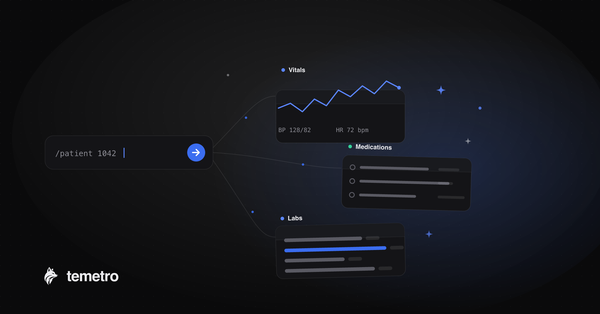
The second wave is conversational access to the record itself. For thirty years the medical record has been a maze of menus. The future looks much more like a conversation. A nurse asks which patients are overdue for a lab and gets a list. A pharmacist asks what stock is running low and gets an answer instead of a spreadsheet. A physician asks for a summary of everything relevant to a patient's kidney function and receives it assembled from labs, medications, and past encounters. The interface disappears, and the information surfaces on demand. This is where a tool like temetro, an open-source clinical workspace whose home screen is a chat rather than a menu, offers a glimpse of the pattern: you ask, and the record answers with clean, organized cards.
Privacy is the feature that decides everything
None of this matters if it is not private. Health data is among the most sensitive information a person will ever generate, and the temptation to pump it all into a distant cloud model is exactly the wrong instinct. The future of AI in healthcare will be defined less by how clever the models are and more by where the data goes when they run.
Two design ideas are becoming non-negotiable. The first is de-identification before anything leaves the building. Before a record is ever sent to an external model, direct identifiers such as name, date of birth, and record number can be stripped and replaced with tokens, so the model reasons about the clinical picture without ever learning whose picture it is. The second is the option to keep the model entirely local. Open-weight models running on a clinic's own hardware, through tooling like Ollama, mean a small practice can use a capable assistant without a single byte of patient data crossing its network boundary. A clinic that self-hosts its software and runs a local model has, in effect, an AI assistant that physically cannot leak what it never had access to. That is a stronger privacy guarantee than any policy document, because it is enforced by architecture rather than by promise.
The quiet revolution: records that belong to the patient
The deepest change is the one almost nobody is talking about, and it has less to do with intelligence than with ownership. For as long as medicine has been computerized, the record has lived in the institution's database. The patient is the subject of the record but almost never its owner. They cannot easily carry it, cannot control who reads it, and often cannot even see it without filing a request.
AI makes an alternative newly practical. Imagine a record that lives encrypted on the patient's own device, where the patient holds the keys. When a clinician adds a diagnosis or a prescription, the change is cryptographically signed and sent to the patient, and it becomes part of their record only once they approve it on their phone. Sharing a record with a new specialist becomes a deliberate act the patient takes, not a back-office transfer they never see. A model can still help organize and summarize that data, but it does so on the patient's terms. This is the idea temetro is building toward with its companion wallet app: a record that is patient-owned by design, where the clinic holds a working copy but the patient holds the original. It is early, and it is being built in the open, but it points at where trust in medical AI ultimately has to come from. People will accept intelligent systems in their care only when those systems are visibly on their side.
What this means for clinics today
The clinics that will benefit most from AI over the next decade are not the ones chasing the flashiest diagnostic model. They are the ones quietly adopting tools that remove administrative drag, that keep data inside their own walls, and that treat the patient as a participant rather than a record to be processed. The technology to do this is no longer speculative. Ambient notes exist. Conversational access to records exists. Local models are good enough to be useful. De-identification pipelines are well understood. And open-source, self-hostable platforms are beginning to stitch these pieces together so that even a small practice can adopt them without signing away control to a vendor.
The future of AI in healthcare, then, is not a dramatic replacement of human judgment. It is a steady removal of everything that gets in the way of it. The best version of that future is quiet, because the software fades into the background. It is private, because the data never has to leave. And it is patient-owned, because the record finally belongs to the person it is about. That is a future worth building carefully, and in the open.